
Perimeter
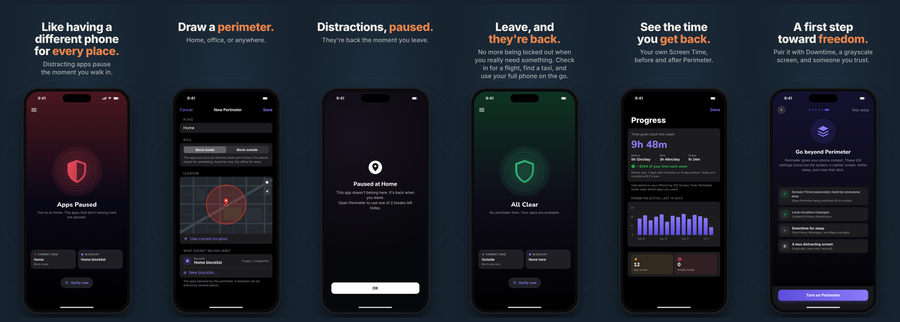
I've been thinking a lot about what I am most passionate about, what I am convinced is important, and how I can actualize it. I think for a long time, I have been in survival mode, trying to get to the other side whichever way I can. Thank God, now I am starting to have some improvements in my health and my work is paying the bills, which lets me think about those bigger questions.
Why this matters to me
I have struggled with screen addiction off and on since I was about 11. I grew up in the late 90's and early 2000's, and experienced first-hand the changes in tech during that time. It went from an exciting thing to a troubling trend in only 10 years or so between my elementary and high school years.
I noticed the trend of screen addiction in myself and the broader culture when I was 13. I immediately put my invenor hat on and sketched out an app that could help people limit their screen time. Most of this vocabulary didn't exist at that time in 2013. We were just starting to realize social media may not be all good, and Apple's Screen Time functionality was years away. Still, I wanted to build an app to help people like me gain balance with their phones, and make the devices work for us, not the other way around.
I didn't know it at the time, but this would become a 13-year journey for me, trying almost every way to limit and tune screen time possible - apps, Apple Screen Time, turning off the internet on my phone, dumbphones, no phone, you name it. Everything I tried had a loophole, a fatal flaw, or was so inflexible as to make it impossible to keep using. I wanted desperately to find a better way.
This year, I discovered I could finally develop apps. With the aid of AI for learning how to create them, I got started. My 13+ year dream was starting to come true. Still, I worked on different apps, offline AI, language learning, etc. Soon however, my dream of using app development to help people (including myself) gain freedom from some of the harmful effects of our devices came back up, and I started developing prototypes: an AI app with no images or explicit content, a basic text-only email app, and a browser with lots of screen time settings and content moderation.
These were great learning opportunities for me - I learned how to conceptualize the app, focus on the core functionality, make the design work, and think of what other people would actually need or use. None of them made it to the publishing stage, though I plan to publish some of them later.
How Perimeter was born
Then, a fateful trip came. I was visiting my sister in New York, and struggling to not waste a ton of time on my devices. I was in a new environment, and I didn't have anywhere to leave my phone or laptop where they'd be out of reach. Eventually, I found a way to store my laptop away from the apartment, but my phone had to stay with me. I used a screen time app to block some apps, but it was rigid and I could easily find loopholes to download apps or get time on the blocked ones anyway.
I started to think - if I am benefiting so much from keeping my laptop outside the apartment, could I simulate the same with my phone? That's when it hit me: I could combine all of my app development experience to create a new app that blocks certain apps on my phone depending on my location! I didn't know if it was possible, but I had to try.
There is one other app that I found that does this, but it had 3-4 major flaws that either let the user find a quick loophole to access their blocked apps or that broke the app entirely. I set out to build the app I knew I wanted.
About a week later, I had my first prototype of Perimeter, and I started to test it as I walked the streets of NYC. I'd cross my app-blocking zone, and like magic, apps like Instagram would grey out and become completely inaccessible. I couldn't believe it! In a way, this was what I wanted to make when I was 13, but even better. I could completely forget about it, leave the apartment and need to rent a bike or buy a train ticket, and all of those apps were wide-open. Then I would return later that night and all the same apps were turned off, allowing me to focus on reading and getting ready for bed.
I found myself reading books, listening to audiobooks, and writing in my journal - I hadn't done any of it this consistently since I was a kid! Something was working, and I had to keep going forward.
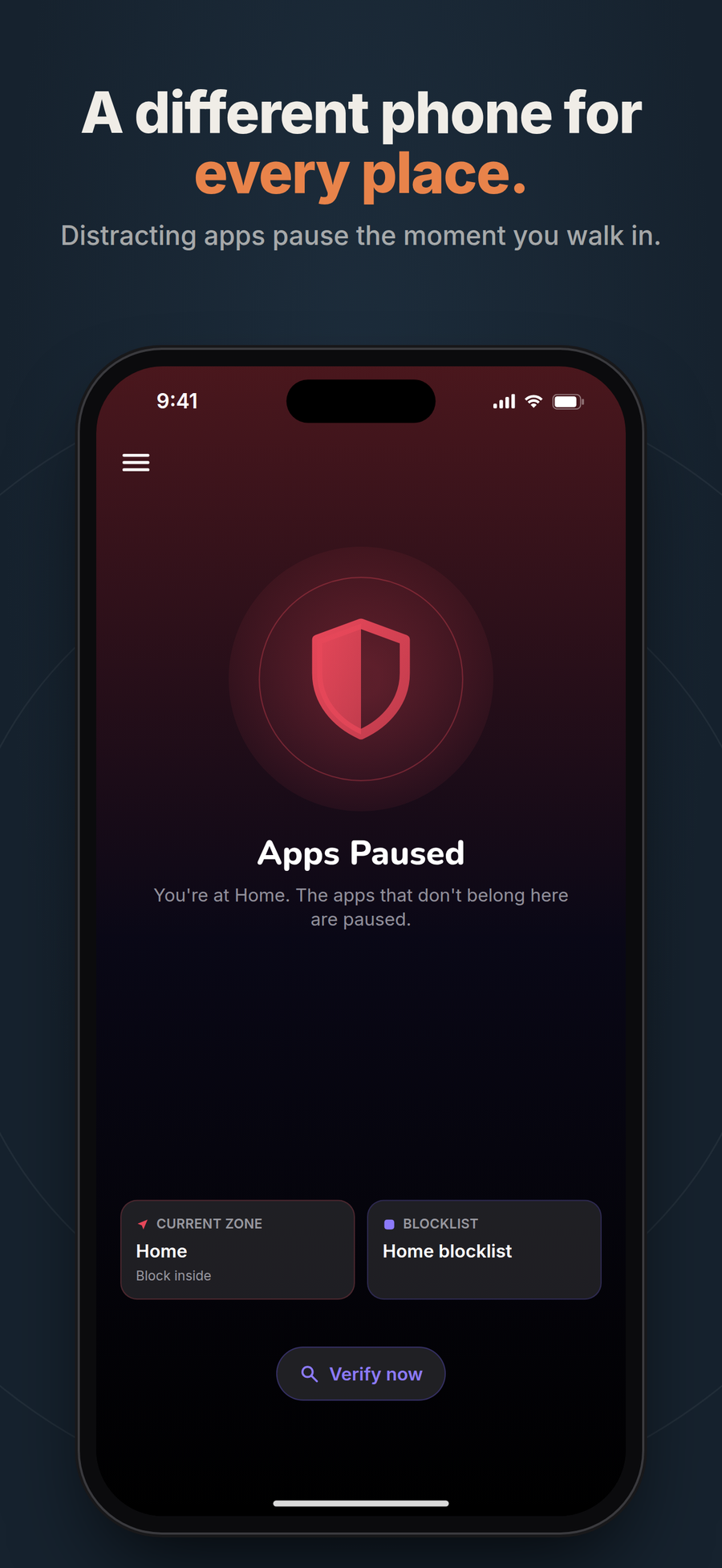 So now, it's with great joy that I present Perimeter to you.
I kept refining and refining, and eventually I became less of a developer of Perimeter, and more of a user. It just worked. It ran in the background, used almost no battery, and without even thinking about it, my apps would be blocked with no loopholes at home or wherever I chose.
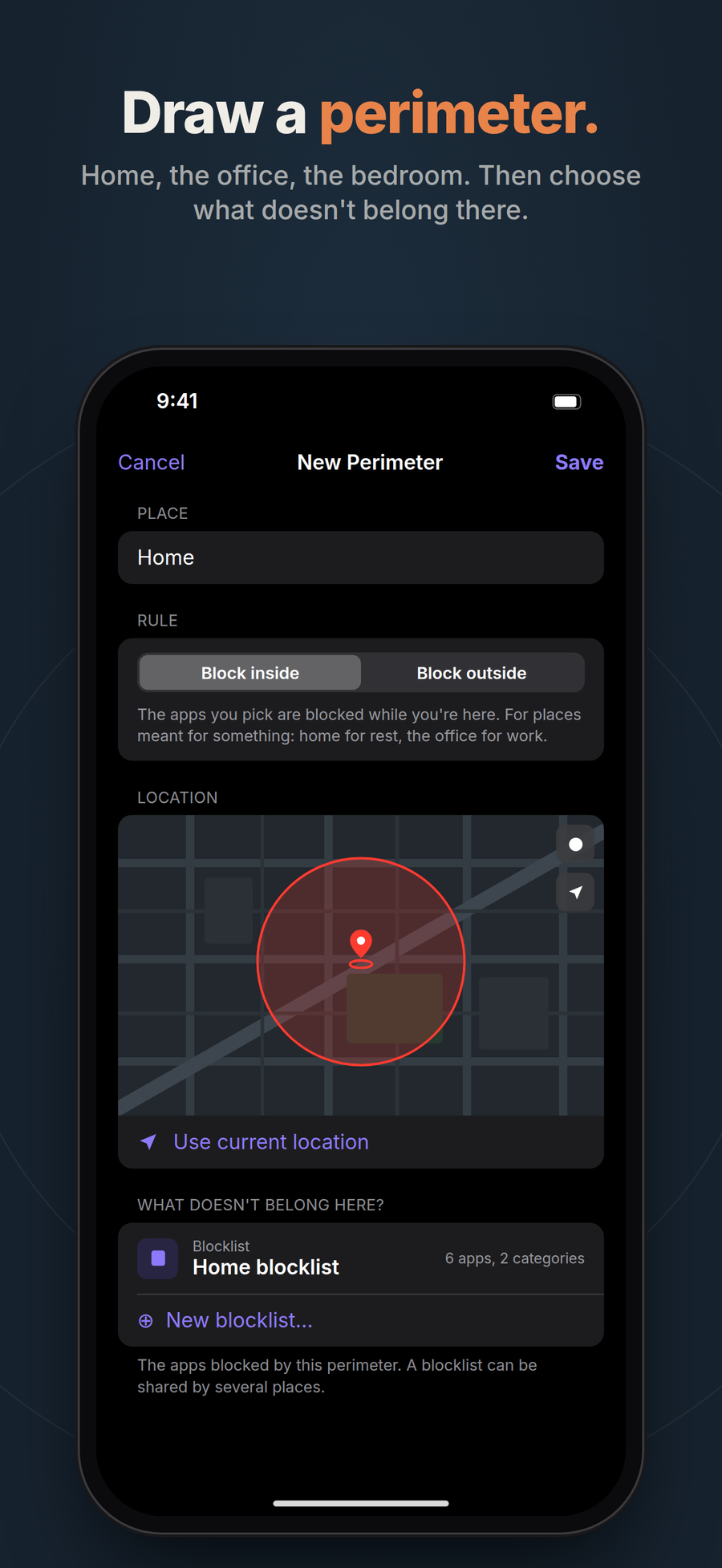
It let me draw a perimeter around my sister's apartment, my house, or anywhere else, and decide what apps did or didn't belong there. Once I set that perimeter, it was locked with a passcode. I only needed that one moment of willpower and foresight to decide to set up the perimeter, and every day I was there, I would have no way of editing the rules I had set before (without one of my trusted friends who knew the passcode).
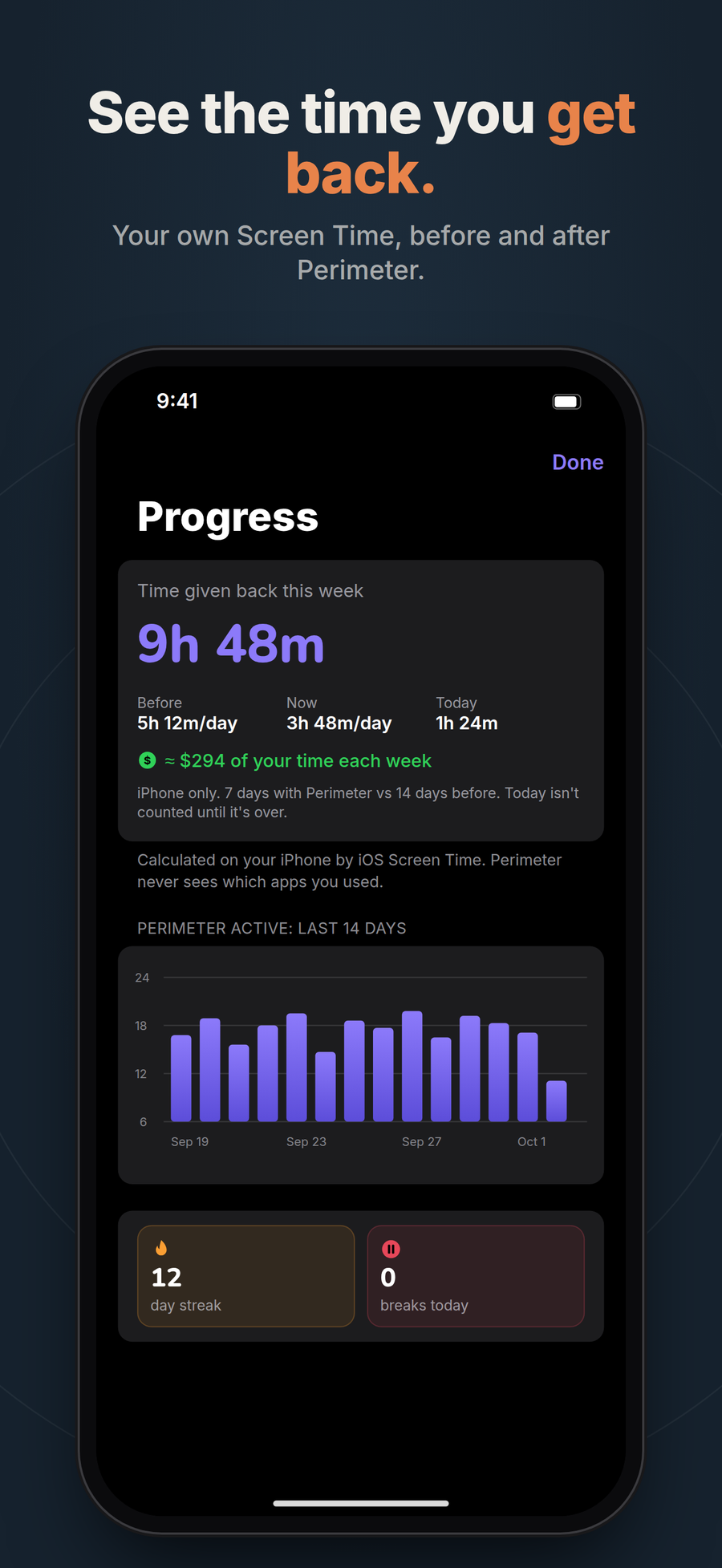
And, pretty soon, I was saving an insane amount of time. This screenshot is actually less than I ended up saving. My average daily screen time went from 5-6 hours down to 2.5-3. And the apps I was using changed a ton - no more doomscrolling, now I was using my phone the way it was meant to be used. Because Perimeter has a breaks feature, I didn't have many occasions I was locked out and needed something, and if I ever truly needed my phone, I would just walk outside the perimeter or wait until I was leaving the area, and they would all turn back on immediately.
Why Perimeter works so well
The reason Perimeter works so well is because we are products of our environment. In a macro sense, we are going to be very different based on our culture we came from, but in a micro sense, our way of thinking changes moment to moment and day to day based on the physical environment around us.
Next time you change environment, take a moment to notice it, it's actually wild. Stepping out your front door will immediately help you think differently, and even more so will walking down the street open up different parts of your brain.
Perimeter works because we are much less likely to doomscroll while we walk down the street or sit in a crowded cafe than we are alone at home. It is an important app because we actually have a key building block in restoring tech to what it was always best at, and restoring home to a place of communion and love and rest.
How our devices got here
What do I mean by restoring tech to what it was always best at? I'm glad you asked. I've realized our technology tree has been on a continuous path for the past 100 years, and likely much longer. Tech has progressively become more engaging/addictive, less communal/shared, more always on, and always accessible. If we track the prevailing mediums of technology over the past 100 years, we went from radio that was in one spot in your home, with a limited selection of programs to listen to, and a nightly sign-off when most programs would go silent. Families would gather around the radio and listen to major news events or weekly programs they particularly liked, and then go about their day. The medium did change the home, but it was still not very addictive, and definitely not overstimulating.
Then came the TV, in black-and-white and then in color. This tracked with movie theaters. Both of these mediums were still communal for the most part, where families or friends would all decide to watch something, go and see it, and at worst, the stations would turn off by 10PM or so anyway. TVs were incredible luxuries, costing $400-$500 in the 1940's, while the average family only made $1,300. Most people would watch TVs in a communal setting, in store windows from the sidewalk, in the local bar, or in a wealthy neighbor's living room. The TV and film in general proved to be a major leap in how engaging content was, but it would take time for them to lower in cost and become more ubiquitous. The first screen addicts were slowly starting to come into existence, but they were still forced to sign off when programs stopped airing at night, or when someone else wanted to watch something instead.
In the 1970's and 80's the number of channels vastly expanded, and addicts were reported as spending up to 8 hours a day watching TV. This is where we see similar numbers to our modern screen time addiction, however that number was their absolute worst-case-scenario, and now, the average adult spends 7 hours a day looking at a screen - and that excludes work hours!! An average knowledge worker who uses a computer all day at work spends more like 11-12 hours per day on a screen, that is the majority of their waking hours.
So now we spend almost as much time on screens on average as the worst addicts did in the 1970's and 80's. That's an incredible stat. What's worse is what has changed about those screens in the intervening time. In the 70's and 80's, most people watched live television, and only had 7-20 channels. If they watched the news, they were watching the same news that their neighbor or a stranger across town was watching. If they watched a cartoon, they would be building cultural knowledge that they would have in common with others. At worst, they were still in a community, even if it was with people outside their home, due to the lack of channels and recorded content.
Fast-forward to the 90's, 2000's, and 2010's, and everything changed. Screens became places to play video games, they got more accessible, smaller, and eventually everyone in a household could have one or two of their own. Recorded content was spreading, so you could stay up later and watch content that kept you engaged for longer. We were starting to isolate with just ourselves and a screen for the first time. This is a time that I was alive to experience, so I can say that even with hundreds of channels and personal video game devices, we still were not using the screens to isolate very often. They had a communal aspect - video games were more fun with a friend, so was a TV show or movie. We hadn't given up on community, even when screens were everywhere.
Then came the smartphone, social media, and YouTube. These completely changed how we understood what a screen could do, and how we understood it to entertain us with infinite options and limited need to share with others. Smartphones had cracked the code on how to tag along with you everywhere, deliver content wirelessly, and seamlessly transition from being a communication device to an entertainment device every afternoon when you got home from work.
This was happening when I was 7-10 years old or so, and it impacted me greatly. As I grew up, I didn't know just how different my world was than the generations before me, and the paradigm shift was so new, no one understood how dangerous it could be to leave kids alone with their smartphone all day and night.
Thesis: Our environment changes how we think
I have studied how our environment affects our way of thinking, and I realized that one of the most profound shifts in our technology in the 100 years wasn't just how engaging it became (sharper picture, more immersive content, color vs black and white), but how private it was. It started to be there, with infinite content options, when we were lonely, tired, stressed, up in the middle of the night. I believe that aspect of tech is more dangerous than anything else. If you were always sitting in public or with friends or family when you used a device, would you use it the same way?
This is why I found Perimeter to be so helpful. When I'm home, I have everything blocked except for the basic functions of a phone (calls, texts, maps). I'm free to focus on home stuff like spending time with family/friends, resting, chores, etc. Then when I go out in public, I allow myself access to my super engaging screen, but with the superpower of a communal/public environment, where I am much less likely to desire entertainment or get stuck in a positive feedback loop of screen addicition. I go home after I work, and everything is off again. It's returning us to some semblance of normalcy, without wiping out the internet or all the benefits it provides entirely.
So, if you made it this far, thank you so much, and I hope you try out Perimeter. I believe if you embrace place-based blocking, it will change your life, and that isn't an exaggeration, since if you're anything like the average American, half or more of your waking hours are spent on a screen. If you can reduce those hours and make the way you spend them of a higher-quality, your life will be better, I can almost guarantee it. Also, unlike other screen time blocks, Perimeter doesn't prevent you from most functionality of a smartphone, it simply prevents access in a few places where you would be most tempted to use it for entertainment or isolation. So no more realizing you can't check in to your flight on the way to the airport because your airline apps are blocked, or not being able to order food because your browser is blocked.
If you're on the go or on a walk, fire away and make your phone work for you. If you're stationary at home, stay present with your loved ones and prep for a great day tomorrow. I hope like heck this app helps you and transforms your family. I believe it has every potential to do so.
I'm looking forward to making more screen time apps in the future, and extending Perimeter into computers and creating a version for schools to help students stay focused during the day. I'm in this for the long haul, until it's more normal to use these tools than to be alone on a screen. I want to turn my mess into my message, and I hope to connect with many others working on this issue as I go.
If you'd like to talk, you can reach me at jack@forpurposelabs.com - have a blessed day and check Perimeter out for yourself!
- Jack